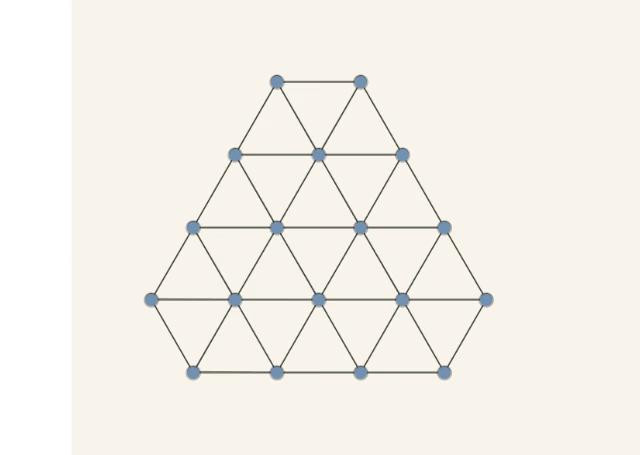
2 joueurs
SnipSnip
- Famille de jeux
- experimental
Présentation
SnipSnip is an outgrowth of 'Tri-It-Out', a pattern capture game, in which the capture pattern involves pieces of both player's symmetrically, and is used to exclude captured sites from immediate replacement. SnipSnip uses more local capture patterns: options of between, or diagonally between, opposing pieces. These patterns are self-limiting in the sense of not allowing cyclic captures. These capture patterns dictate dead sites that typically result in alternating linear and honeycomb arrangements of pieces with tactical exceptions. In addition the goal of 'SnipSnip' is changed from 'Tri-It-Out's 'most pieces' to 'largest Group', which creates greater drama and opportunities for turn-around tactics, and is the reason for the SnipSnip name. 'Tri-It-Out' is Misere. 'SnipSnip' also includes non-Misere variants.
Règles de la source (anglais)
SnipSnip is a 2-player strategy game It may be played: -- on a hex grid -- on a square grid -- on a square plus diagonal grid Goal: Largest Group (in Misere, the largest Group loses.) Definitions: A Group is a set of all the pieces that can be reached from any one of them by a series of steps, where a step means movement from one piece to another of the same color, next to it. Note: For the Diagonal-Linked Group options a step also include diagonals (double-steps that are not in the same grid direction). A site is a board intersection. 'Between' Variant: -- A Capture site is any site adjacent to two stones of opposite color in the same line (i.e. directly between them.) 'Diagonal' Variant: -- A Capture site is any site adjacent to each of two stones of opposite color, where those stones are not on the same grid-line. Play: Players take turn, starting on an empty board with White to play. On a turn 1) The mover places to an empty site that is not a Capture site. 2) Then, if possible, the mover removes one of the opponent's checkers from a Capture site that lies adjacent to the placement just made. In the case of Misere, the mover must take an additional turn after each capture. Otherwise, the next player becomes the mover. The game ends when no placement is possible. In the case of a tie, the player who would have been next to place loses.