2 joueurs
Shogi
- Famille de jeux
- shogi
- Origine
- Japan
Présentation
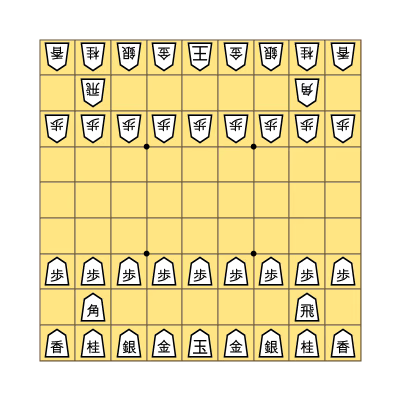
Shogi is a capturing game that is native to Japan. Early evidence suggests it was played in some recognizable form during the Heian Period. It has been hugely popular since then in Japan, and today is known throughout the world. It originated ultimately from Indian Chaturanga, like many other games such as Chess, Shatranj, and Xiangqi.
Règles de la source (anglais)
Pieces move as follows: Osho(1): moves one space in any direction Hisha(1): moves any number of spaces orthogonally. Kakugyo(1): moves any number of spaces diagonally. Kinsho(2): moves one square in any direction except diagonally backwards. Ginsho (2): moves one square diagonally or one square forward orthogonally. Keima(2): moves one space forward and then one space diagonally forward. Kyosha(2): moves any number of spaces only forward or backward. Fuhyo(9): moves one space forward. Pieces are promoted when reaching the opposite third of the board. Pieces are captured when an opponent's piece moves to the space it occupies. Captured pieces are held and can re-enter the game under the control of the capturing player as their turn. The goal is to capture the other player's king.