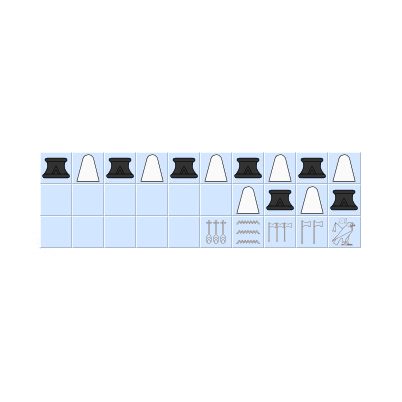
2 joueurs
Senet
- Famille de jeux
- escape
- Origine
- Egypt
Présentation
Senet is one of the oldest board games known in the world, documented from about 3000 BCE until the first millennium BCE in Egypt. It was also played In Cyprus for most of that time, and played at different times in the Levant. Though a full ruleset has never been found, hints from texts and tomb paintings in Egypt give us clues about the manner in which it was likely played. The game was also heavily imbued with religious significance, as the board itself represented the journey through the afterlife.
Règles de la source (anglais)
Seven pieces per player, which begin on the board, alternating spaces from white to black along the track. Four throwing sticks, marked on one side and blank on the other, used as dice. The values of the throws are equal to the number of blank sides up, when no blank sides are up the throw = 5. Throws of 1, 4, and 5 grant the player another throw. All throws are made before moving, and a piece must move the full value of one throw at a time. Players alternate turns throwing the sticks, and the first one to throw 1 plays as white and moves the white piece in front. When a piece lands on a space occupied by the opponent's piece, the opponent's piece is sent back to the space where the piece that captured it moved from. When a player has two or more pieces in consecutive spaces, these pieces cannot be sent backward in this way. If a player cannot use a throw to move a piece forward, it must be used to move a piece backward. If a backward move makes a player's piece land on a space occupied by a piece belonging to the opponent, the opponent's piece is sent to the place where the player's move began. If a player cannot move, the turn ends. Spaces 26-30 provide special rules allowing the player to bear off. To move beyond square 26, the player must first land on it with an exact throw. From there, the player may: bear off with a throw of 5; move to square 30 with a throw of 4 and bear off on any subsequent throw; move to square 29 with a throw of 3, but it must stay there until borne off with a throw of 2; move to square 28 with a throw of 2, but it must stay there until borne off with a throw of 3. Pieces in squares 28 and 29 are never required to move backward and bearing off is not required from any space. When a player lands on squares 28-30 and an opponent's piece is already there, the opponent's piece is sent to square 27 instead of 26. When a piece is in square 27, whether by being sent there as described above or by being forced to use a throw of 1 to move into square 27, the player may either move the piece back to square 15 and lose one turn, or may leave the piece in square 27 until a 4 is thrown, bearing the piece off. A player cannot move any other piece on the board when one remains in square 27 or 15 after being sent back to it, and pieces which normally would be protected from bring sent back because they are next to each other may now be sent back. Pieces in squares 28-30 are safe as long as a piece is in square 27. The player in square 27 may decide to give up trying to throw a 4 on any turn and move this piece back to square 15 and lose their next turn. The first player to successfully bear off all their pieces wins.