2 joueurs
Daldos
Daldøs
- Famille de jeux
- all
- Origine
- Scandinavia
Présentation
Daldøs is a capturing game played in Scandinavia. Though it was on the wane in the nineteenth and twentieth centuries, it had somewhat of a revival when it was sold commercially. It was likely to have been much more widespread, as evidenced by its persistence in regional Danish dialects and its similarity to games games in Norway and Finland. It is remarkably similar to the game Tab, played in North Africa and Southwest Asia.
Règles de la source (anglais)
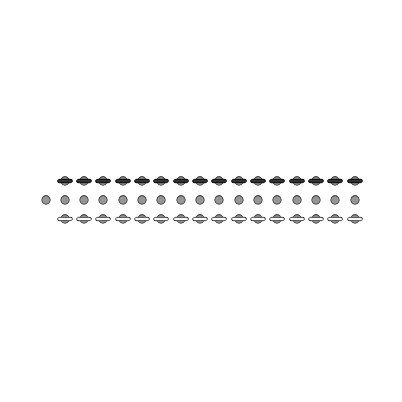
Three-row board, outer rows with sixteen holes and the central with seventeen. Sixteen pieces per player, which start the board in each of the holes in the outer row belonging to a player. Two four-sided dice, marked 2-4 and 'A' for 1. The throw of double 1s gives the player an extra throw. Players move their pieces according to the throws of the dice, moving one piece the value of one of the dice and another the value of the other die, or one piece the value of both dice. A piece cannot be moved until it is 'activated' with a throw of 1. When a piece is activated, it is rotated 90 degrees and moved one space. One player moves from left to right in their row into the central row, moving right to left down it and when reaching the end of the central row, proceed into the opponent's row, and move from left to right in it, returning to the central row upon reaching the end. The opponent follows the same track, except moving from right to left in their row. Opponent's pieces are taken when a player's piece lands in the same spot as the opponent's piece. When in the opponent's row, the player my captured as many pieces of the opponent as hypothetically allowed by the dice. Players may not move one of their pieces past one of their other pieces. The player who captures all of the opponent's pieces wins.