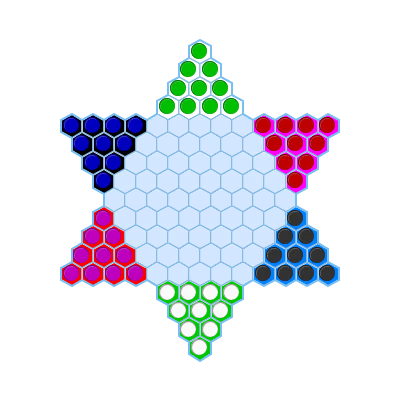
6 joueurs
Chinese Checkers
- Famille de jeux
- fill
- Origine
- Germany
Présentation
Chinese Checkers, originally known as 'Sternhalma,' was invented in Germany in 1892 as a variant of the older American game Halma. It was called Chinese Checkers as a marketing ploy in the United States in 1928.
Règles de la source (anglais)
The game can be played by two, three, four, or six people. It is played on a board that is shaped like a six-pointed star with 121 holes for the pieces. Each point of the star has ten colored spheres and the goal of the game is to move all of one's pieces into the opposite point of the star. Players can move a piece to one adjacent hole, or can jump either their own or opponent's pieces. This does not result in capturing, and jumping is not mandatory. When fewer than six people play, players can play with only one color of pieces, but if two or three people play they can use more than one color, but each player must use an equal number of pieces.