2 joueurs
Adhesion
- Famille de jeux
- experimental
Présentation
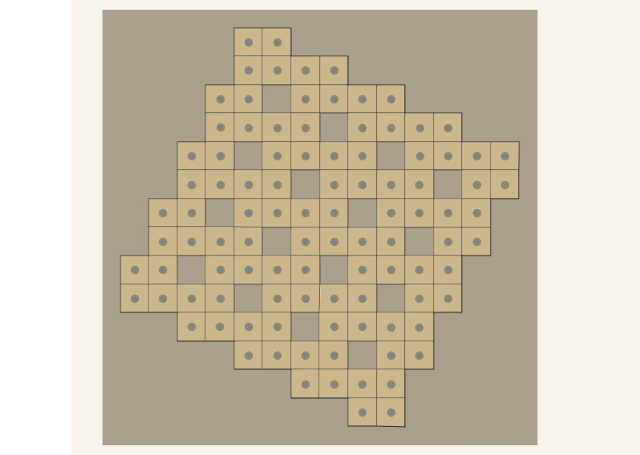
'Adhesion' is a refinement (simplification) of 'Epoxy' which in turn is a version of 'Shaka' (my ancestor game a few other games including my game Situ.) Shaka was a territorial lines-of-sight game based on out-of-sight entry, sliding moves, increasing stone contact, capture by enclosure and double-pass ending. 'Adhesion' and 'Epoxy' are Line-of-Sight games without capture played on 'perforated' grids. The perforations reduce the number and distance of the piece sight-lines, making a Line of Sight game more playable. All this family of games uses a double move protocol as standard. Stones must increase contact, effectively locking stones in place as they neighbor more and more opponent's stones; thus creating territories that can be filled, as well as zones that are dead for movement and/or placement. The difference between 'Adhesion' and 'Epoxy' are: 1) 'Adhesion' only counts the change in adjacencies of the moving piece, 'Epoxy' allows movement to neighborhoods with the same adjacency count if lines of sight increase 2) 'Adhesion' is on an adjacent-square-grid, 'Epoxy' is played on a hex grid. 3) 'Adhesion' is pure territorial, 'Epoxy' is a survival game, with emergent territory. In both, turns may be partially passed. In 'Epoxy' part of the strategy is knowing when to slow down and play cold. In Adhesion passing almost never changes the outcome. Tactics include to cloud pieces to prevent opponent placements, and to 'adhere' to opponents pieces to prevent their movement and to create walls in favorable locations. This implementation allows playing both games on a variety of boards and grids, as well as a couple more difficult line-of-sight variants.
Règles de la source (anglais)
Board type according to the options Standard Goal: Most territory (An Option to use the 'Epoxy' last-to-move goal is available) The first player (Maroon) places a stone, after which the players alternate turns, taking up to two moves per turn. To move, either: 1. Add a stone to an empty space that is out-of-sight of any opponent's stone. -Or, 2. Slide a stone along a straight line to a new position with restrictions given according to the Sliding Option selected for the game. (Shown below) Game ends when one player cannot take a turn, or when neither player can slide on their turn. Territory is stone count plus number of possible placement sites. Ties go to player 1.