2 joueurs
20 Squares
- Famille de jeux
- escape
- Origine
- Mesopotamia
Présentation
20 Squares appears for the first time at the beginning of the second millennium BCE. It seems to be derived originally from the the Royal Game of Ur, becoming particularly popular in Iran, the Levant, Egypt, and Cyprus in addition to Mesopotamia during the Late Bronze Age (1700–1050 BCE), and continued being played in Mesopotamia into the Seleucid period, at least until the second century BCE. It may have been called É Er-bé-et-ta, 'Room Four,' which is mentioned in cuneiform tablets.
Règles de la source (anglais)
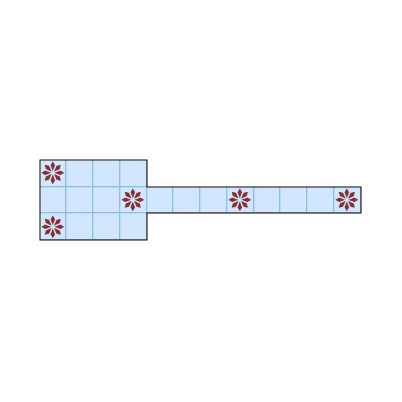
Boards consist of a grid of 3x4 squares and a continuation of the central row in the grid that extends for 8 further squares. The game is played with two astragals as dice: one from a sheep and one from an ox. The sheep astragal provides the base value for the roll, and the ox astragal serves as a bonus. Rolls of the sheep astragal produce values of 1, 2 ,3 or 4. The ox astragal produces a 'yes' or 'no' value. If 'no' is rolled, the values remain the same. If 'yes' is rolled, the value of the first roll is boosted to 5, 6, 7, or 10, respectively. These rules are proposed by Finkel based on the values of moves provided in the cuneiform tablets (Finkel 2007: 21–22). Each player starts play on one of the right corners of the 3x4 grid, proceeding left down that row to the opposite corner, and then right down the central track, which both players use, with the goal of moving off the end of the track. If a player lands on a square occupied by the opponent, the opponent's piece is removed from the board and may reenter on a subsequent turn. Rosettes on certain squares in the central track mark spaces where a player is safe from being sent to the beginning. Rosettes in the corners allow a player to roll again when a player lands on them. A player wins when they remove all seven of their pieces from the board by rolling the exact number of spaces left in the track, plus one.