2 players
Sarvatobhadra
- Game family
- chaturanga
- Origin
- India
Overview
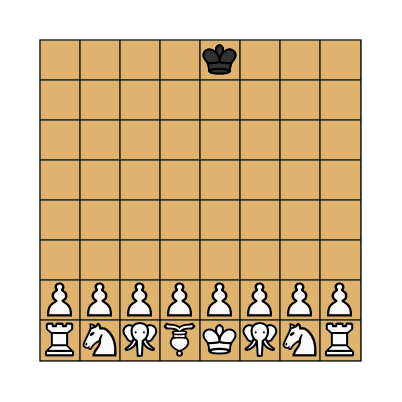
Sarvatobhadra is a variation on Chaturanga played in medieval India, documented in the Manasollasa. It is played with dice, and one player plays as the king against the opponent's full complement of pieces.
Source rules (English)
Played on an 8x8 board. One player plays as one Raja, the other with the following pieces: 8 Bhata (or Padati; move like Chess pawns but without being able to move two on the first turn); 2 Ashva (horses; move like Chess knights); 2 Gaja (elephants; two spaces in any orthogonal direction, jumping over the first square); 2 Ratha (chariots; moves like a rook in chess); 1 Mantri (counselor; moves one square diagonally in any direction); 1 Raja (king; moves one square in any direction). These are set up along one edge of the board: Ratha-Ashva-Gaja-Mantri-Raja-Gaja-Ashva-Ratha, with the eight Bhata lined up in the row in front of these, as in chess. The player with the full complement of pieces rolls a six-sided die to determine which piece to move: 6=Raja, 5= Mantri, 4=Gaja, 3 = Ashva, 2=Ratha, 1= Bhata. The player with the single Raja can move it according to the moves of any piece. Players take turns moving. When one piece lands on the space occupied by another piece, it is captured. The goal of the player with a full complement of pieces is to block the single Raja so that it cannot move. The Goal of the single Raja is to checkmate the opponent's Raja.