2 players
Royal Game of Ur
- Game family
- escape
- Origin
- Mesopotamia
Overview
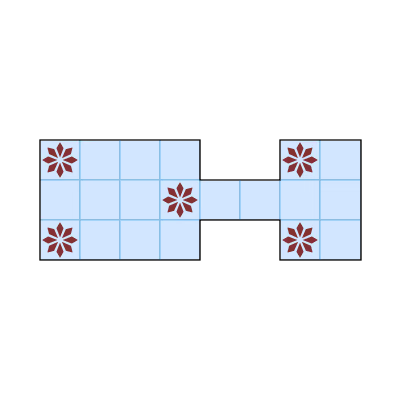
The so-called Royal Game of Ur—we do not know its ancient name—is one of the oldest known board games, dating to the third millennium BCE. While no rules have been passed down for this game specifically, a rule set based on a successor game, 20 Squares, has been applied to this slightly different board. The board consists of a grid of 3x4 squares, connected to a grid of 3x2 squares by a short bridge of 1x2 squares connecting the central rows of the other two grids. The game was played with four tetrahedral dice and 7 small disks per player as playing pieces.
Source rules (English)
Each player starts play on one of the top corners of the 3x4 grid, proceeding down that row to the opposite corner, and then up the central track, which both players use, and then turning back toward the original side of the track when reaching the top of the central track in the 2x3 grid. If a player lands on an opponent's spot, they are removed from the board and may reenter on a subsequent turn. A rosette in the center of the central track marks the spot where a player is safe from capture. Rosettes in the four corners allow a player to roll again. A player wins when they remove all seven of their pieces from the board by rolling the exact number of spaces left in the track, plus one.